

Fructose Market to Reach USD 33.1 Billion by 2036, Expanding at 6.0% CAGR as Food and Beverage Demand Strengthens
Fructose Industry
Global fructose demand rises across beverages, bakery, and dairy as food processing growth and formulation needs reshape sweetener strategies.
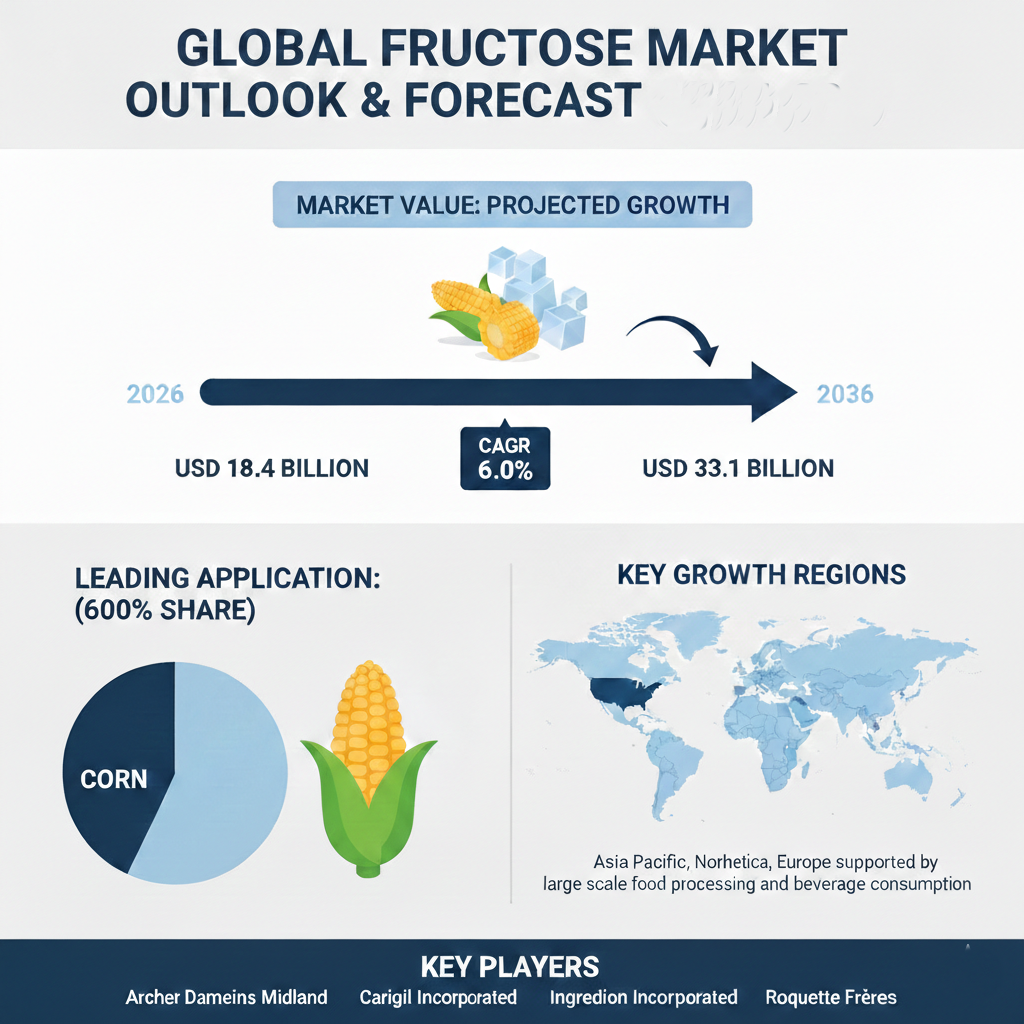
NEWARK, DE, UNITED STATES, January 30, 2026 /EINPresswire.com/ -- The global Fructose Market is valued at USD 18.4 billion in 2026 and is projected to reach USD 33.1 billion by 2036, expanding at a 6.0% CAGR. The industry is closely linked to worldwide food and beverage manufacturing, where fructose is used for its high sweetening intensity, solubility, and formulation stability. Strong demand from beverage systems, bakery applications, and processed foods continues to anchor long-term consumption.
Fructose plays a functional role beyond sweetness. It supports moisture retention, browning performance, and texture control in bakery and dairy products while enabling consistent quality in high-volume production. Confectionery manufacturers rely on fructose to achieve targeted taste profiles while maintaining cost efficiency. Industrial uses in pharmaceuticals, fermentation, and nutritional formulations further diversify demand.
Explore trends before investing – request a sample report today! https://www.futuremarketinsights.com/reports/sample/rep-gb-2108
Market Context: Functional Performance Driving Ingredient Adoption
Fructose continues to maintain relevance across food processing workflows where sweetness optimization and cost control are central. Its higher sweetening intensity compared to sucrose allows manufacturers to achieve target taste profiles using lower inclusion rates. Confectionery producers use fructose to balance sweetness while managing formulation economics, reinforcing its position in mass-market food segments.
Industrial applications further expand market scope. Fructose is incorporated into pharmaceutical formulations, fermentation systems, and specialized nutritional products that require controlled carbohydrate content. These diversified uses add resilience to demand beyond core food and beverage categories.
Source and Product Insights: Corn and High Corn Syrup 55 Lead
By 2026, corn is expected to account for approximately 60% of global fructose production, supported by established agricultural supply chains, high yield, and efficient conversion infrastructure. Government policies supporting corn cultivation and advancements in farming practices continue to strengthen long-term feedstock reliability.
On the product side, High Corn Syrup 55 is projected to hold a 38% market share. Its balanced sweetness, stability in beverages, and cost efficiency make it a preferred choice in soft drinks, baked goods, and processed foods. The product’s 55% fructose composition enhances solubility, fermentation performance, and moisture retention, enabling consistent integration into existing production systems.
Industry Drivers, Constraints, and Technology Trends
Market expansion is influenced by growing demand for reduced-sugar and clean-label food formulations. Fructose is used in reformulation strategies to help manufacturers meet sweetness targets while maintaining taste integrity.
However, the industry faces challenges including raw material price volatility, particularly for corn and sugarcane, and regulatory scrutiny related to sugar consumption. Labeling standards and dietary guidelines in parts of Europe and North America increase compliance complexity.
Producers are responding through enzyme-based conversion systems, automated purification lines, and continuous processing technologies. These advancements improve yield stability, purity, and production efficiency while enabling specialized fructose variants such as crystalline fructose and high-purity liquid grades for pharmaceutical and functional nutrition applications.
Country-Level Growth Highlights
Growth varies across key economies between 2026 and 2036:
• India: CAGR of 12.8%, supported by rapid food processing expansion and beverage demand
• China: CAGR of 6.8%, driven by beverage, bakery, and snack manufacturing
• Germany: CAGR of 6.5%, led by premium bakery and dairy sectors
• South Korea: CAGR of 6.4%, supported by functional beverages and desserts
• Brazil: CAGR of 6.3%, influenced by juice and soft drink production
• United Kingdom: CAGR of 6.1%, linked to sugar reduction reformulation
• Mexico: CAGR of 6.0%, driven by processed food and beverage manufacturing
Competitive Landscape
The fructose market operates within a competitive structure shaped by raw material access, processing precision, and long-term manufacturer relationships. Major participants include Archer Daniels Midland Company, Cargill Incorporated, Tate & Lyle PLC, Ingredion Incorporated, and DuPont de Nemours Inc. Companies focus on supply reliability, purity control, and application-specific performance to meet evolving formulation and regulatory requirements.
Key Players in the Fructose Market
• Archer Daniels Midland Company (ADM)
• Cargill Incorporated
• Tate Lyle PLC
• Ingredion Incorporated
• DuPont de Nemours Inc.
Browse Related Insights
Glucose-fructose Syrup Market: https://www.futuremarketinsights.com/reports/glucose-fructose-syrup-market
Crystalline Fructose Market: https://www.futuremarketinsights.com/reports/crystalline-fructose-market
About Future Market Insights (FMI)
Future Market Insights, Inc. (FMI) is an ESOMAR-certified, ISO 9001:2015 market research and consulting organization, trusted by Fortune 500 clients and global enterprises. With operations in the U.S., UK, India, and Dubai, FMI provides data-backed insights and strategic intelligence across 30+ industries and 1200 markets worldwide.
Sudip Saha
Future Market Insights Inc.
+1 347-918-3531
email us here
Legal Disclaimer:
EIN Presswire provides this news content "as is" without warranty of any kind. We do not accept any responsibility or liability for the accuracy, content, images, videos, licenses, completeness, legality, or reliability of the information contained in this article. If you have any complaints or copyright issues related to this article, kindly contact the author above.
